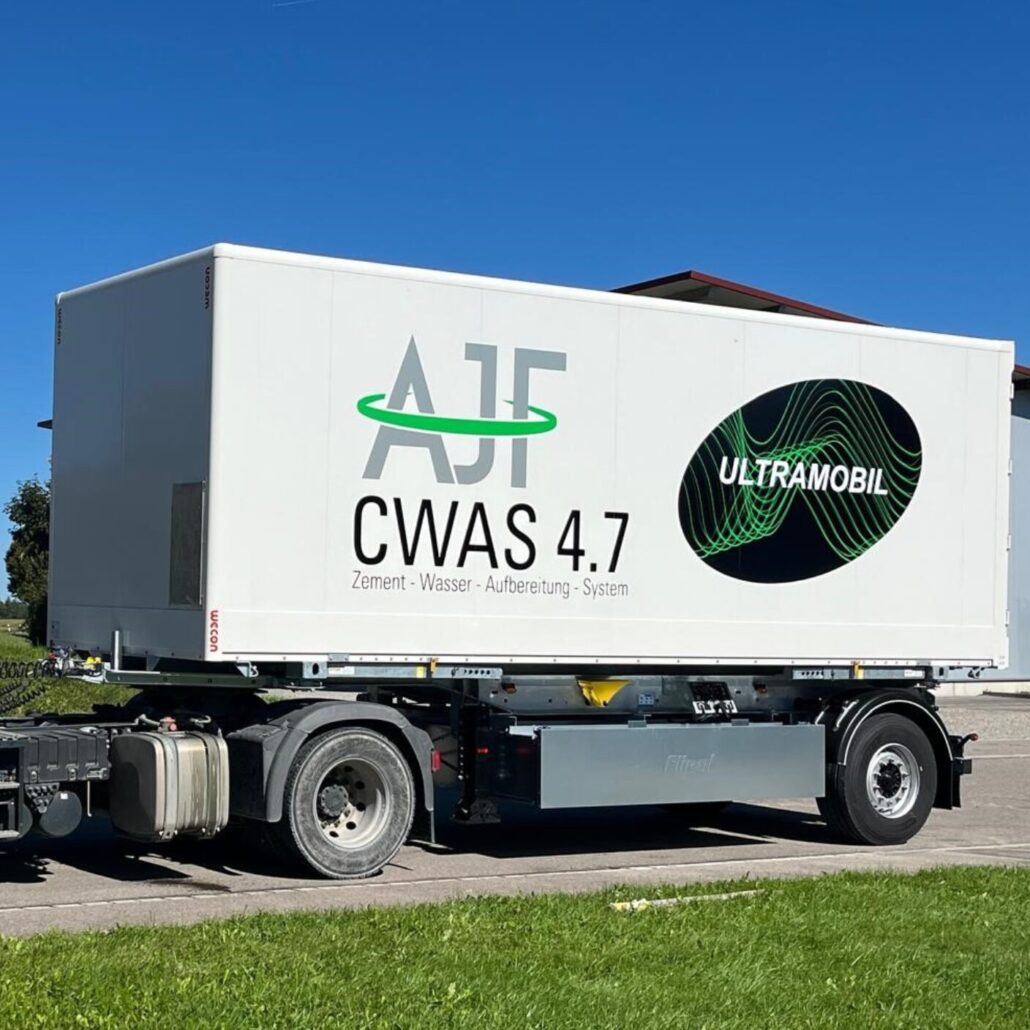










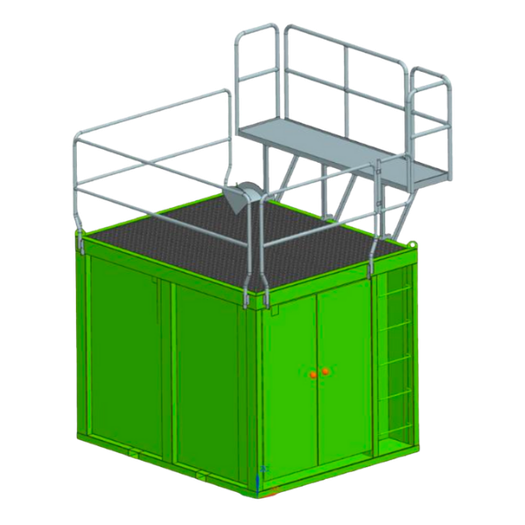
The mobile concrete separation tank from AJF is ideal for use on construction sites and in precast plants.
Advantages of the mo-BAT mobile separation container:
- You save a lot of time when dealing with wet sludge without dredging and obtain dry sludge directly.
- You save enormously on disposal costs thanks to excellent sludge dewatering.
- Easy transport and handling thanks to integrated crane eyes and forklift pockets
- They meet all necessary environmental requirements, even with pH neutralisation.
- Special filter bag (filter big bag) for ideal filtration of the water
- You can clean your concrete buckets and tools directly on the construction site.
- Save cleaning water
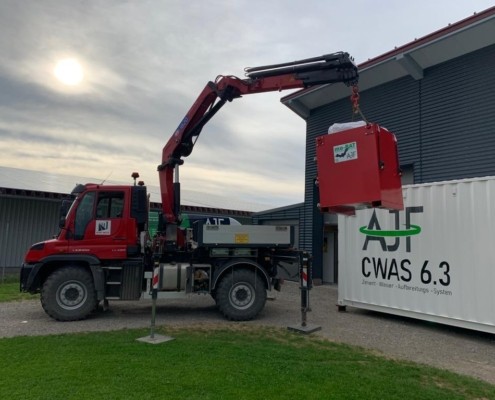
Mobile waste water separation tank, ideal for construction sites
The container is specially designed for washing concrete buckets or other washing applications.
It is equally suitable for use on construction sites as it is in precast plants, for example.
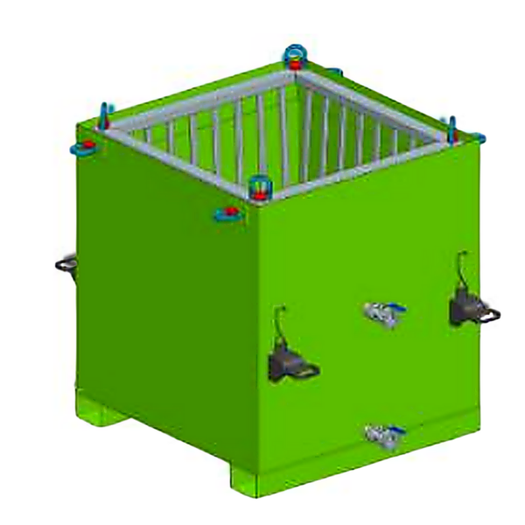
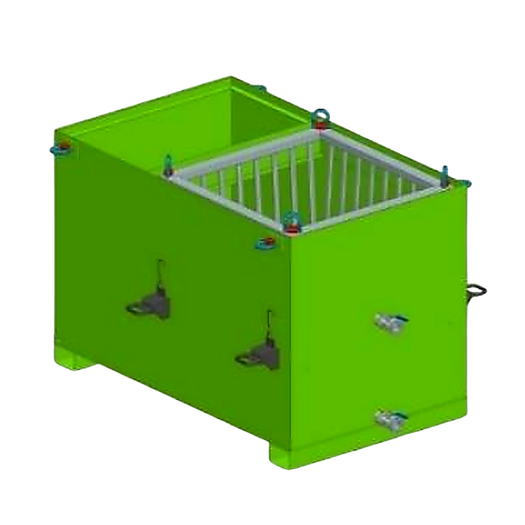
The solids in the water are separated using a specially developed Big Bag filter and remain in the Big Bag.
The filtered water can be drained via two different outlets.
If additional pH neutralisation is necessary, this can be easily added.
How can mo-BAT help your business?
Construction site water has a high content of mineral fines and a pH value in the range of 11–13, which corresponds to the value of caustic soda.
Discharging into the sewage system or waterways is therefore strictly prohibited. It would cause considerable damage to the sewage system or the environment.
Environmental organisations are increasingly addressing this issue and inspecting a wide variety of construction sites to check whether, for example, water protection systems are in place. Violations of these requirements result in heavy fines and strict conditions for future projects.
Appropriate drainage containers or settling basins are necessary. In Switzerland, these facilities are often referred to as water protection facilities.
How do settling tanks work?
Settling tanks for construction site wastewater are usually steel tanks or steel containers with partition walls of varying heights. The construction site water is fed into the containers and the fine particles contained in the construction site water settle through sedimentation.
Once the sediments have settled, the water is drained from the settling tank via a raised outlet.
What are the disadvantages of settling tanks?
The separation of sediments and water does not normally take place continuously. The water remains in the settling tank for some time until it can be drained off.
Alternatively, settling basins are dimensioned to be sufficiently large and long so that the sediments settle during the slowed flow and the water exits without sediments at the outlet.
It requires either a lot of time or a lot of space.
What is the alternative to settling tanks?
The mobile concrete water separation tank mo-BAT
The container is specially designed for washing concrete buckets or other washing applications.
It is equally suitable for use on construction sites as it is in precast plants, for example.
The construction site water or wash water is fed through a specially developed Big Bag filter. The sediments are separated here and remain in the Big Bag.
The filtered water can be drained via two different outlets.
This method saves space and separates sediment and water almost just in time.
What further steps are necessary for the treatment of construction site wastewater?
Depending on the regulations, additional pH neutralisation of the construction site water may be necessary. In most cases, the pH value of the water must be below 9. In Switzerland, for example, water with a pH value above 9 may not be discharged. In most cases, the pH value must even be below 7.
How is the pH value lowered?
This step takes place in the so-called neutralisation tank. With the mo-BAT1000+ or mo-BAT3000, the neutralisation tank is already provided for in the overall container.
The wastewater from the filter big bag flows through overflow plates into the neutralisation tank. There, the cleaned water is treated with CO2, which lowers its pH value. The treatment continues until the desired pH value is reached.