









Smart concrete recycling closes the loop! Germany uses a good 47 million cubic metres of concrete – every year! Concrete is therefore the undisputed number one building material. Unfortunately, this also means that resource consumption and disposal requirements are growing. How can cement slurry and cement be disposed of? Clever concrete recycling is stepping in to solve the disposal problem. What is needed to reuse concrete components such as cement slurry and the like in concrete production?
Fresh concrete recycling: systematic treatment of cement slurry
In addition to solid concrete recycling (demolition concrete, etc.), fresh concrete recycling prepares uncured residues from concrete production for further use. This is because systematically treating residual concrete water means less wastewater has to be discharged – and fewer trips to the landfill. How does it work? Through concrete production that benefits from a functioning cycle. It starts in the evening: the concrete mixers return to the plant, with much more valuable residual concrete still in the truck mixer drum and concrete pump. Surveys show that the proportion of concrete recycling in the production of many concrete plants has so far been less than three percent. Surely that can be increased! That’s right, starting with a residual concrete washing plant that is also suitable for small ready-mixed concrete plants and mobile concrete recycling. Disposing of cement? Here, the viscous cement is separated from the aggregate in the fresh concrete as a binding agent and sorted into coarse and fine grains for the next production run.
Where are regulations governing aggregate for concrete and the recycling of cement slurry as additive water?
In Ri5, Guideline for the production of concrete using residual water, residual concrete and residual mortar, German Committee for Reinforced Concrete (DAfStb). All raw materials used in concrete production must be safe, healthy and fit for purpose. According to DIN EN 1008, residual water from washing out truck mixers may also be used as mixing water. The ideal ratio of residual water to fresh water is determined by the desired concrete quality and the concentration of fine particles. Homogeneously distributed solids are required – all others must be separated into the settling tank.
Perfect cement water treatment – through water density standardisation
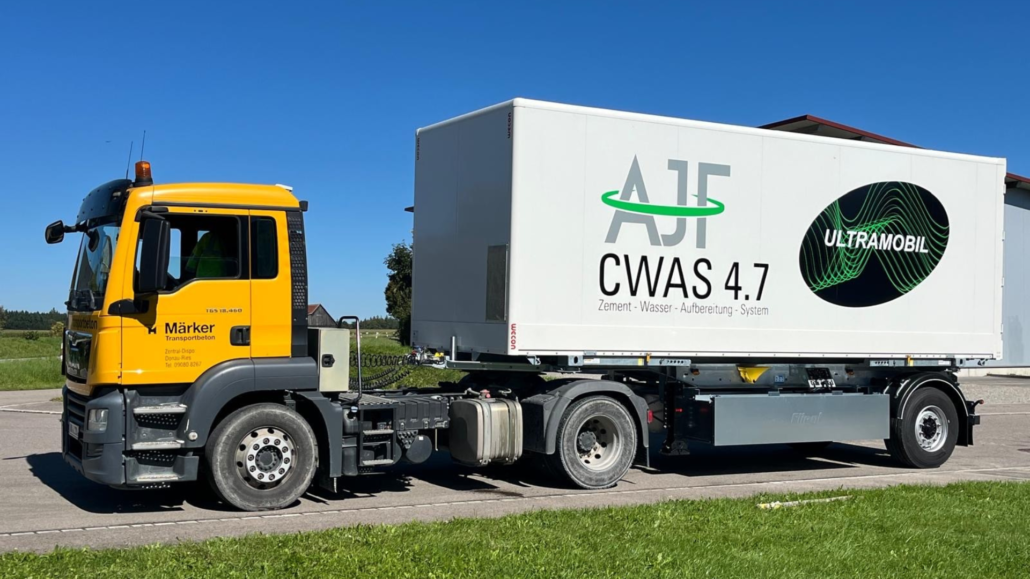
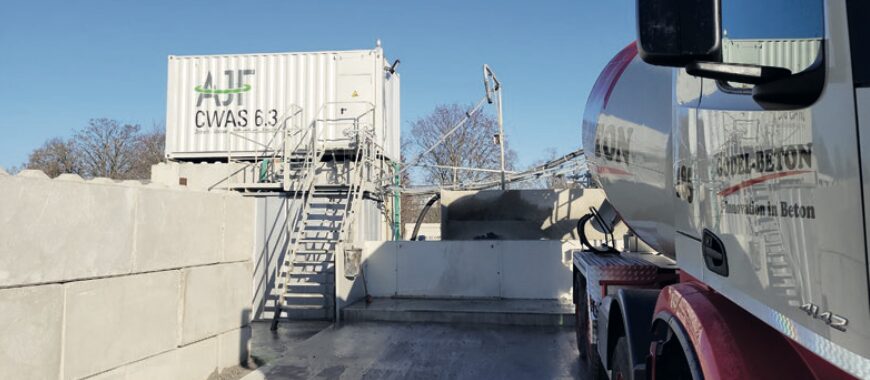
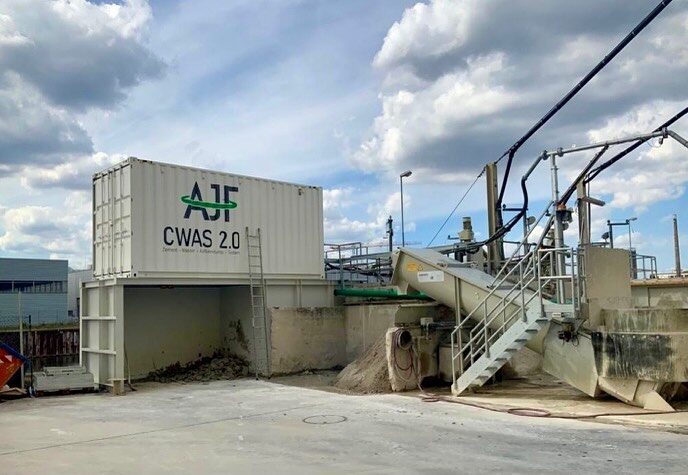
Is your residual water tank overflowing again? Yes, disposing of cement water and concrete slurry is expensive. The alternative? Concrete recycling! Just imagine that everything stays where it is. Ready to be cleaned and recycled on site around the clock. Up to 100 per cent of the water recovered in this way is used in the production of fresh concrete; residual water is distributed evenly over the daily production. Then, when you expect the highest water density, you must determine the residual water density (in kg/l) – at least once a day. Fully automatic residual water recycling with CWAS as a patented cement-water treatment system creates a closed raw material cycle and meets all requirements for a consistently low residual water density of 1.07 kg/litre. A system that you can use both stationary and mobile, because it is integrated into
a transportable container, anywhere and all year round – even in winter
. Because you use less clear water thanks to residual water utilisation, have less residual water to dispose of and save valuable materials from landfill, you can produce your concrete at a measurably lower cost. Where sediments are processed to the maximum, they can be reused as aggregates. At the same time, you comply with all water specification parameters. This is made possible by water density standardisation: depending on the material, you must achieve certain density values. CWAS allows you to freely preselect these values. This also applies to the pH value of the return water. Grain size processing and binder dosing round off the fully automatic system.
Where to put the remaining water – into the public sewer system?
Stop: Before discharging residual water as waste water, it must comply with water law pH limits – in other words, it must undergo effective waste water neutralisation. Tailored to your specific operational requirements
, such as wastewater volumes, an AJF pH neutralisation system in a mobile container works for you, customised to your company, from initial planning to commissioning. It handles the entire neutralisation process, from pH value determination to final pH control, fully automatically.
Its low-maintenance evaluation station reliably checks the solids content and turbidity. Manually reading measured values? Checking whether parts need maintenance? This is not necessary here, because a controller display module retrieves all sensor values. And if certain components require maintenance, the system reports this automatically. This allows you to discharge any wastewater without hesitation.
Flocculation: Concrete recycling is optimised water recycling …
… that uses water as economically as possible! Effective chemical flocculation plays an important role in this. The goal: to transform finely dispersed substances into macroflocs – not just any old how, but in a predictable manner. The more precisely this is achieved, the smaller the quantities that slip through the mesh during filtration. Your company-specific flocculant station with a single or multi-chamber system prepares polyelectrolyte solutions professionally, according to your needs and fully automatically. When the flocculant is running low, the (optional) sensor in the dosing station
alerts you. Compact dimensions make the system suitable for smaller plants as well. In addition, a modular microfilter station cleans the water of many types of tiny particles using suitable special filters – from quartz filters to zeolite filters. You decide for yourself how many you need for this filter cycle in the pressure vessel.
How do you make your filter presses more efficient?
Instead of constantly buying new filter cloths, it makes sense to improve the filter properties first. It is best to clean filter cloths daily by covering them with cleaner or applying sufficient pressure to remove stuck mineral particles from the filter press. To do this, a high-pressure gun applies a highly acidic active cleaner directly to the filter cloth; its surfactants are biodegradable. Cleaning that is intensive and quick, but does not smell bad to you or the environment.
Modern concrete recycling is climate-friendly
Unfortunately, CO2 emissions are immense wherever lime is burned: the cement and concrete industries are among the main contributors to greenhouse gases. Furthermore, the production of concrete consumes vast amounts of water, gravel, sand and cement. These are resources that are becoming increasingly scarce globally: the German cement industry has been committed to sustainability since 2002. After all, those who invest in climate-friendly innovation are (more) successful. The value chain of cement-bound building materials is showing progress; the concrete and cement industry is a partner in the circular economy. But if you want to increase energy and resource efficiency and combine ecology and economy, you must – last but not least – commit to modern concrete recycling.
Lucrative concrete recycling: Disposing of cement is a thing of the past!
Current research into the use of fine particles from concrete recycling plants as a cement component also confirms that every detail counts in concrete recycling. Intelligent systems such as CWAS help to optimise processes and condition water as required. Every single concrete recycling plant is unique because it is tailored to specific requirements. There is no better way to use intelligent technology, which runs at peak performance with constant, automatic density monitoring. It’s high time to relieve your staff of time-consuming tasks and continuously incorporate concrete recycling results into production: as soon as CWAS starts working, you pay less – for personnel, logistics and environmentally friendly disposal. The ROI can be seen after only a short period of time. In short, it’s a real treasure!