









Precision concrete production costs money, time and personnel. One key factor in the equation is the handling of recycled water! Godel Beton in Stuttgart, known nationwide for relevant projects of various sizes, is now rethinking the treatment of cement residual water in a sustainable and fully automated way – together with AJF.
Work quickly, use resources sparingly
For Godel and its subsidiary Godel-Rohstoffe, which operate in the ready-mixed concrete, gravel, sand and metallurgical cement segments, the careful, energy-saving use of resources is a matter close to their hearts. A pioneer in the field of innovative concrete mixing plants, the company based in the middle Neckar region stands for selected raw materials. And it knows that whether it’s a large-scale project or a private house build, every delay makes the project more expensive. Clever equipment now saves Godel time and disposal costs when dealing with concrete slurry. The new AJF water treatment plant not only guarantees a consistently low residual water density, it also meets all environmental requirements.
Return concrete and water back into the cycle
If you want to make concrete production cheaper, you have to save cement. Unfortunately, a large proportion of the more than 47 million cubic metres of concrete produced annually in the UK ends up on the inside wall of the mixer drum. That is why the new approach is to reuse the resulting concrete residues and concrete recycling water for production. What does this require? A treatment plant that continuously determines the solid content. The more precise this is, the more residual water returns to the cycle at a constant density. In the battle for precise residual water density, Godel has discovered industrial water treatment – through AJF Technologie from Egg an der Günz, Unterallgäu.
Customised concrete, EN 1008 specifications fully met
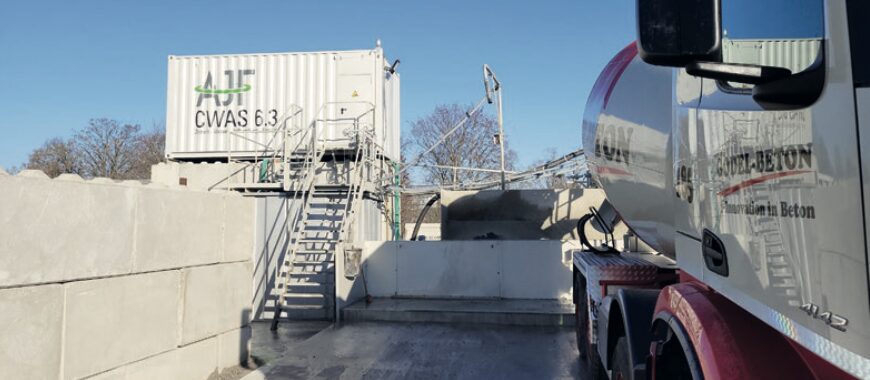
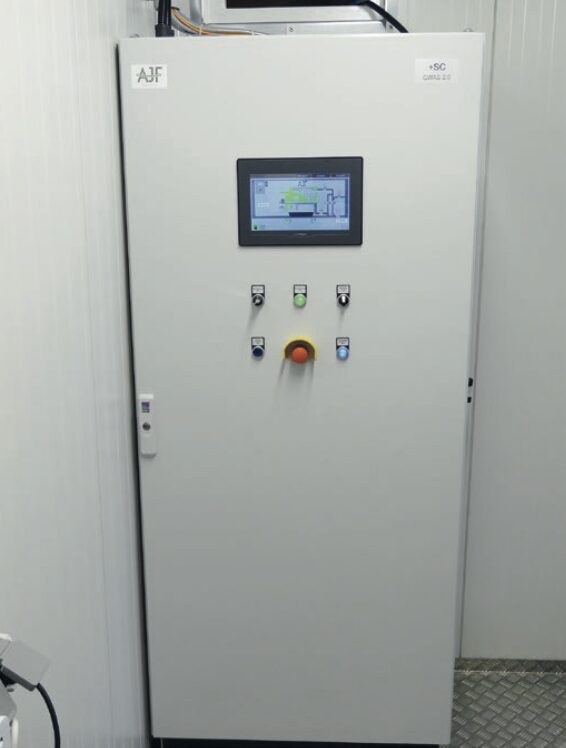
The challenge: Excess residual water usually causes (disposal) problems. And anyone who adds cement to achieve a certain quality and component strength and compensates for fluctuations in residual water density is pursuing an expensive strategy that is not very environmentally friendly. According to the Ready-Mixed Concrete Association, the production of 1 tonne of cement generates around 550 kg of CO2. With the AJF system, Godel will in future meet the EN 1008:2002 requirements for the use of recycled concrete water, benefit from density measurement in terms of precisely tailored concrete quality – and distribute the recycled water in a cement-saving and environmentally friendly manner throughout daily production. AJF’s patented CWAS with intelligent control technology ensures a consistently low recycled water density in accordance with DIN EN 1008 – fully automatically, all year round, even in winter.
Water density standardisation
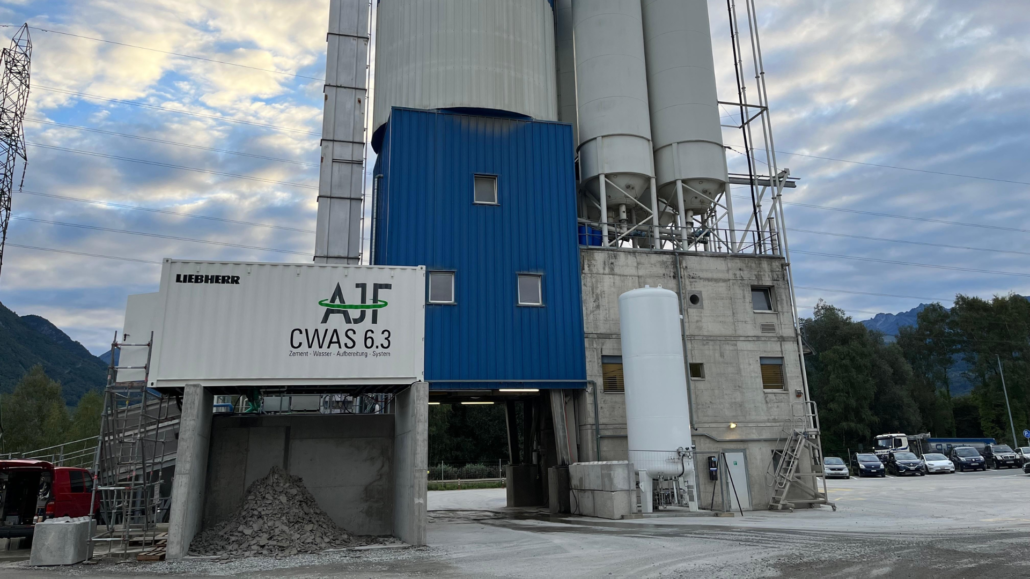
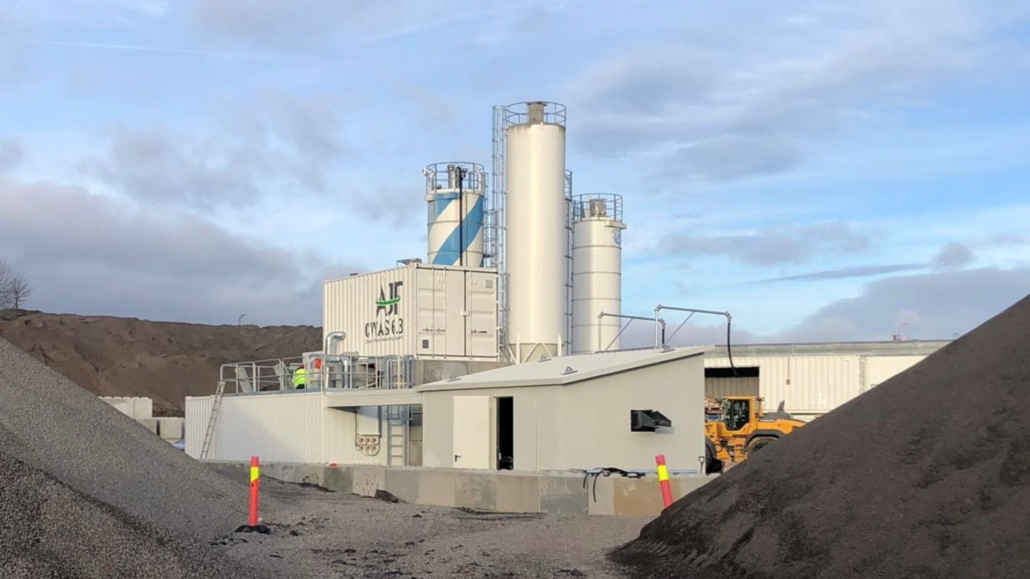
AJF water treatment continuously measures density, with values immediately fed into production control. The key feature is water density standardisation: Godel simply selects the desired water density of the residual water, while complying with all water specification parameters. The modular concept of cement-water treatment is tailored in every detail to the company, capacity and plant location – from residual water basins to cisterns. Coupled with sensors, CWAS makes every task easier, whether it’s probe control or retrieval of (wastewater) values. Once the maximum density value has been recorded, it is reduced by targeted sediment removal or the addition of fresh water. Sediments and cement water no longer have to be disposed of at great expense. Godel reuses them in the production of very high-quality concrete – and saves many litres of fresh water per cubic metre.
Objective: Maximise potential savings in cement
Godel had long since figured out which constant density achieved the best strength. And because Godel already uses computer-assisted project management in all its plants, it was time to use a fully automated solution in water treatment as well – and the Bavarian company AJF had just the thing. Given the company’s requirements, Godel had very specific wishes for the new concrete technology plant: please maximise the potential savings in cement and CO2. Zacharias Funk, Head of Maintenance, sets up and dismantles the concrete plants: “The AJF plant helps us enormously in our daily handling of concrete slurry – and it is very reliable. We use it for about 16 hours a day. Additional cement added to the concrete recipe? No longer necessary, because perfect mixing water now ensures key properties of concrete quality such as setting time and compressive strength.”
Excellent conditions for cost-effective concrete and relaxed working
But AJF’s winter-proof cement water treatment plant is ideal for Godel for another reason: Godel transports the raw materials for its innovative concrete mixes using mobile concrete mixing plants, with delivery and conveying coming from a single source. Godel develops its own concrete mixes and market innovations for many projects.
Owner Stephan Godel is passionate about tailor-made concrete construction solutions. The optimal location for a mixing plant is one that saves on raw material and transport costs while keeping CO2 emissions low. Patrick Schäffler, Head of Building Materials Technology in Ready-Mix Concrete Quality Assurance, is responsible for this – and Wladimir Blehm, Head of Scheduling and a long-standing member of the Godel team, delivers the concrete to the customer. Every AJF plant arrives pre-assembled so that the concrete producer can get started right away with plug & play.
From Lidl to Zeiss – Godel makes it happen
A lot has happened since Godel-Beton built its first mobile mixing plant for large-scale projects in the Stuttgart area in 1997: Godel-Rohstoffe now produces innovative, sustainable aggregates and binders. Godel Transportbeton has also been present in Poland for over twenty years – and in 2017 it conquered the Philippine market with concrete for Manila’s metro system. In 2018, Godel was involved in the construction of Lidl Germany’s headquarters, where space for 1,500 employees had to be created on 130,000 square metres in a very short construction period. No sooner said than done: the mobile mixing plant with a 3.3 m3 mixer delivered the required total concrete volume of approximately 145,000 cubic metres. At Zeiss, on the other hand, precision was the main motto: in spring 2024, Zeiss Hightech Jena needed floor slabs with specific vibration properties – a prerequisite for Zeiss production machines to work precisely even in the nanometre range. Large-scale concreting that could not be interrupted in order to avoid the risk of unevenness during hardening.
Sustainable travel
Godel-Beton stands for over three decades of high-quality concrete, delivered quickly and precisely to meet your needs – for building construction and civil engineering, large construction sites, and private house building. A third of the more than thirty locations are even CSC Gold certified, including the supply chain. CSC stands for Concrete Sustainability Council and is a seal of approval for ecologically, socially and economically responsible business practices in the raw materials, cement and concrete industry – right down to the electric concrete mixer. Godel is rather proud of this and welcomes school classes to construction sites such as Stuttgart 21 to inspire the civil engineers of the future. Godel and innovative AJF water treatment are a perfect match – together on the path to successful smart sustainability.