










Residual concrete is valuable! An efficient concrete recycling plant ensures that primary raw materials from residual concrete and residual water are not wasted – whether in concrete construction, ready-mixed concrete or precast plants. This is because residual concrete can be easily processed and water from concrete recycling can even be reused directly. Provided that you use advanced manufacturing technology and a modern residual concrete washing plant – and follow all the rules for environmentally friendly water treatment.
Why do you need a residual concrete washing plant?
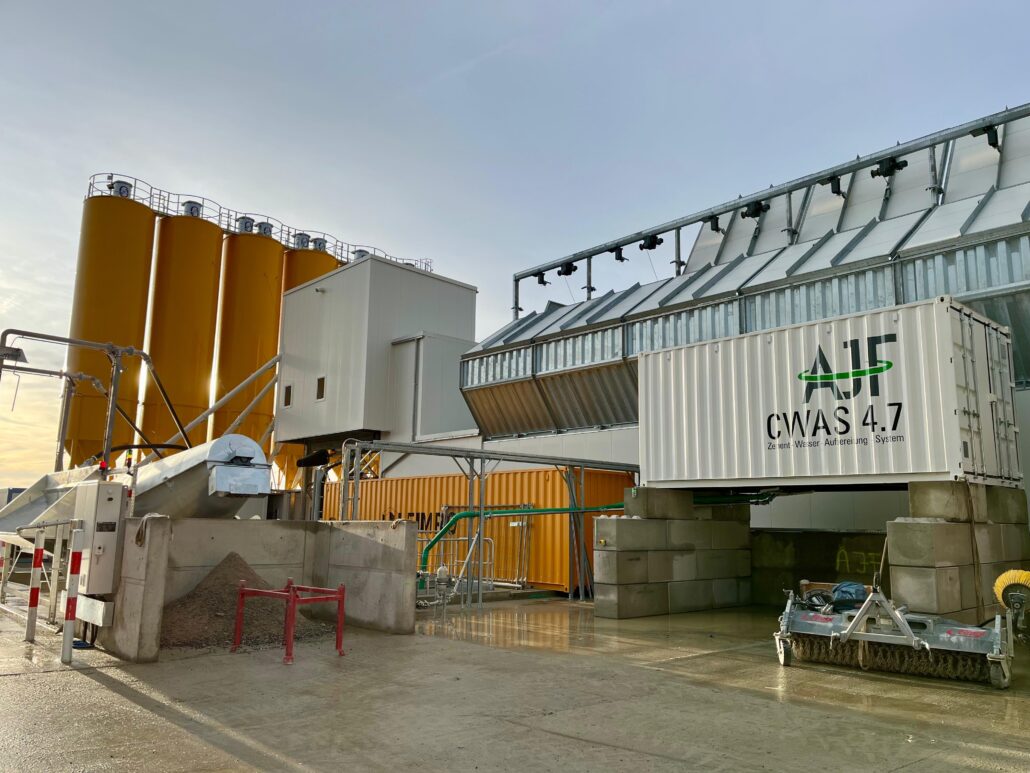
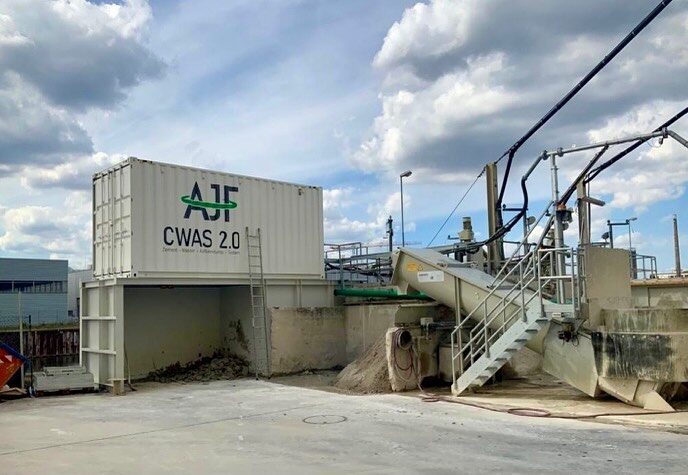
A long day of production comes to an end: the empty mixer truck is back. Really empty? Not quite, because there is still a lot of high-quality residual concrete in the mixer drum and concrete pump! A residual concrete washing plant recovers residual concrete in such a way that the sand and gravel it contains can then be reused (and cement-free) in the mixing plant. When washing out uncured concrete, residual water (grey water) is recovered in addition to aggregates. To do this, the mixer truck driver drives up to the residual concrete washing plant and positions a flushing boom over the vehicle’s hopper: recycling water, march! The mixer drum is thoroughly rinsed, and excess water and fine particles leave the mixer truck via a special drainage system.
What regulations apply to residual water?
Please note that residual water contains not only aggregates and cement, but also water used to wash out the mixing vehicles and concrete pumps, as well as any rainwater. It is therefore an aqueous suspension of fine particles with a maximum grain diameter of 0.25 mm. Only a certain percentage of the total quantity may consist of jointly processed but different aggregates. Higher quantities are permissible if they are of the same type as the primary aggregate – separated into coarse and fine grains. The reuse of residual water as added water and recovered aggregates for concrete is regulated by the “Guideline for the production of concrete using residual water, residual concrete and residual mortar” of the German Committee for Reinforced Concrete (Ri5).
What parameters must be observed for watertightness?
Yes – residual water that accumulates during the washing of truck mixers in the residual concrete washing plant may be added to the mixing water during concrete production in accordance with DIN EN 1008. When recycling residual water, the permissible ratio of residual water to fresh water depends on the fine particle content and the desired concrete quality. Residual water used as mixing water contains fine particles in varying concentrations. If solids are not homogeneously distributed in the residual water, they must be separated in a settling tank. Whenever you expect the highest water density, the residual water density (in kg/l) must be determined at least once a day. Even better: ensure that the residual water density is determined continuously around the clock.
But how do you determine the solids content?
Official tables list it based on density determination and the amount of residual water added. Does the residual water not meet the water density requirements of DIN EN 1008? Then you can still add enough of it to comply with the limit values of the requirements in relation to the total amount of water added. In this case, the dry solids content (kg/l) and the residual water volume (l/l) must be considered in relation to the density of the residual water added. 2.1 kg/l is considered to be the average solids density; a residual water density of 1.07 kg/l is ideal. This corresponds to a solids mass of 0.134 kg/l – with a residual water volume of 0.936 l/l.
How does water density standardisation work?
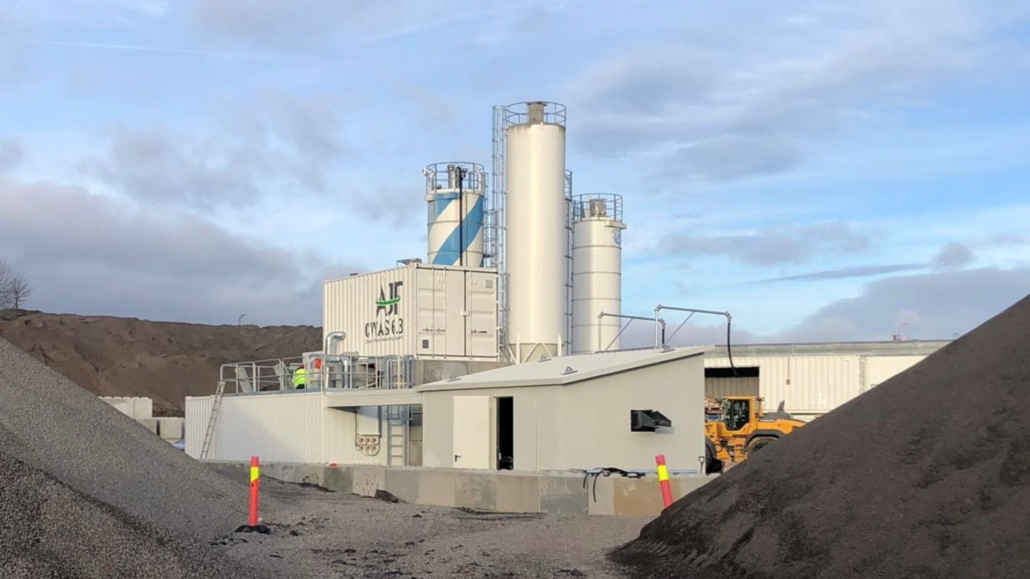
However, residual water cannot be used in concrete without restriction. Fresh water is required for demanding high-strength concretes or aerated concretes. Residual water may only be used if the additional input of solids does not exceed a certain percentage and the residual water is distributed evenly across the daily production. Sounds complicated? Innovative cement-water treatment plants such as CWAS 2.0 can be used both stationary and mobile and treat concrete water in an uncomplicated manner – all year round. They deliver a consistently low residual water density of 1.07 kg/litre. The patented system works according to the principle of water density standardisation.
You can now preselect the desired water density and pH value precisely. This provides the ideal conditions for using concrete residual water not only proportionally, but also in accordance with DIN EN 1008 and 100 percent for concrete production. Intelligent control technology automatically ensures a constant water density. Where a complete raw material cycle is implemented, the costs for residual water disposal and clear water are reduced. In addition, you have less sediment waste because sediments are processed to the maximum extent possible so that they can be reused as aggregates. A residual concrete washing plant that is also suitable for smaller ready-mix concrete plants and as a mobile concrete recycling plant.
As a concrete producer, how do you deal with wash water? With a residual concrete washing plant, you are in control.
With a residual concrete washing plant, you are in control. Every concrete recycling plant should be a coherent, holistic system and a customer-specific recycling solution! An innovative residual concrete washing plant paves the way for more environmentally conscious use of materials. An investment in an effective residual concrete recycling system pays for itself after a short time – the savings achieved through this functioning material cycle are measurable. Intelligent water treatment, ideally from a single source, uses valuable resources sparingly – to your cost advantage and to protect the environment.