









There’s still something in it! Process water and residual concrete are too valuable to end up in drains and waste. Efficient residual concrete recycling sends cement water and concrete residues back into the cycle. Recycling systems 2025 treat residual water in a simple and cost-effective manner – and also recover finer aggregates from the residual concrete. Curious to find out exactly how this works? Read on…
What can a concrete recycling plant do?
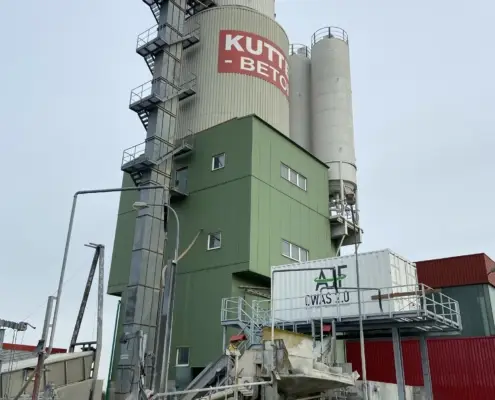
A long day is coming to an end: time to wash out the truck mixers – and each one still contains a fair amount of concrete gold. Smart residual concrete recycling ensures that nothing goes to waste. The size of the concrete plant or construction site is secondary. Innovative processing has everything you need to get started right on the spot. Such as a low-maintenance screw conveyor that adapts flexibly to requirements. Or a feed table that is precisely matched in design and size to the largest ready-mixed concrete plant. Because modern concrete recycling as an overall concept covers everything that is continuously produced – from rinse water full of solids and active cement components to the residual concrete itself. Reusing process water saves expensive fresh water – and recycling residual concrete saves valuable primary raw materials. Here, solids return directly to the material flow and mixing plant; coarser aggregates are strategically sorted out. What remains then ends up, in the best case, as filter cake – for reuse or proper disposal.
Separate, clarify, dewater, neutralise – tailor-made!
Concrete recycling plants operate according to the counterflow principle (flotation), capable of washing out sand and aggregates from 0.2 to 32 mm, so that only the finest (cement) particles up to 0.2 mm remain in the residual water. This is called a separation cut, and should not only be stated in the machine’s data sheet, but should also be the case in reality! This is because residual concrete recycling only works where a plant is operated in accordance with its capacity. If you overload your system, the separation cut is no longer guaranteed. In other words, your complete concrete washing solution should match the required capacity in every element – and everything should be compatible with each other. A pleasant side effect: the reuse of your raw materials can now be planned!
What results are achieved by residual concrete recycling and water treatment?
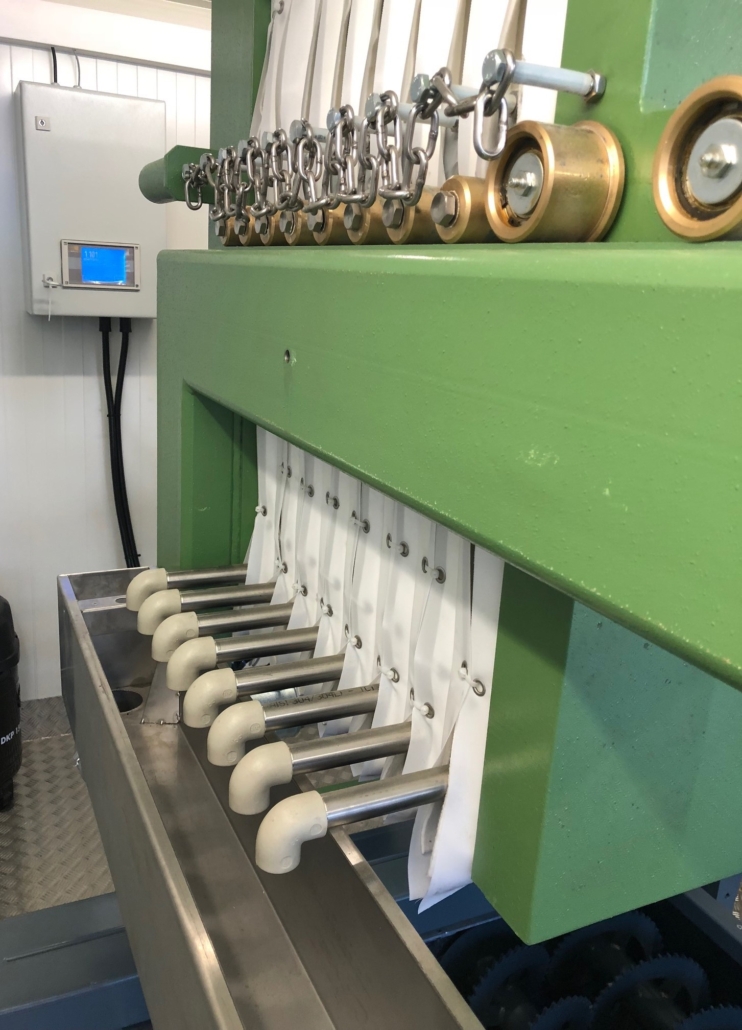
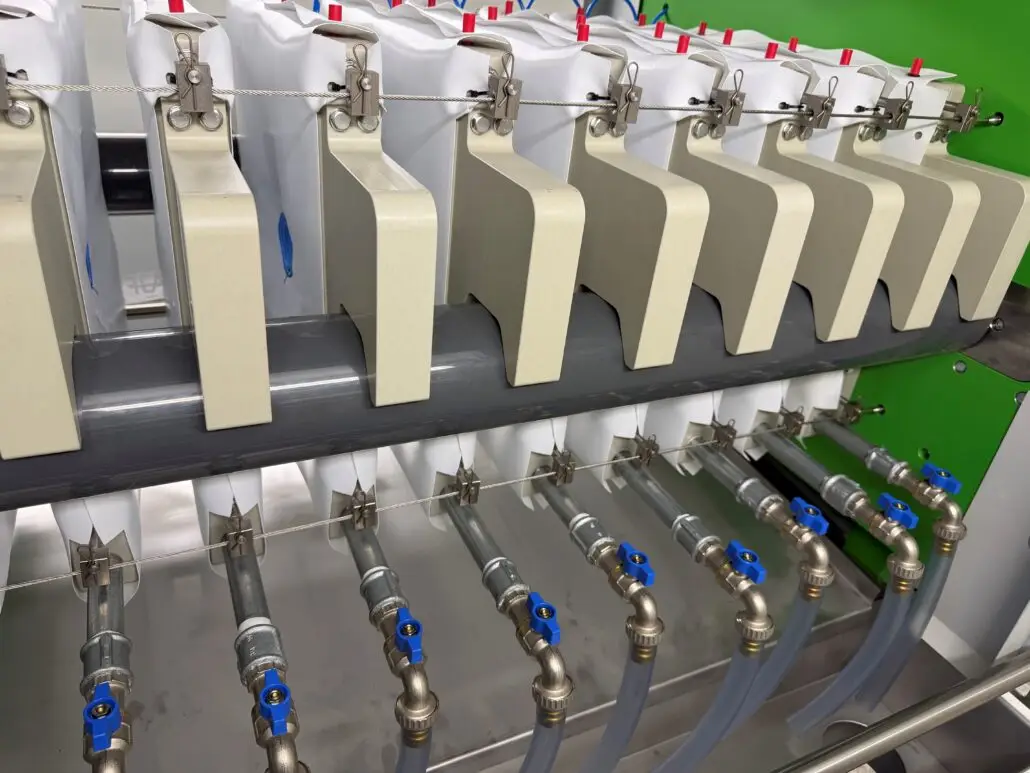
Depending on individual requirements, additional level and density probes, pumps and agitators complete the concrete recycling process, ready to convey between 8 and 25 cubic metres of residual concrete per hour, depending on the size of the plant, and cover all areas of precast concrete and ready-mixed concrete production. The goal: sand and gravel aggregates that are as dry as possible and perfectly washed, achieved by means of a screw conveyor or an ascending vibration and dewatering trough. Once the residual cement water has passed through the plant, it flows into the agitator tank and is pumped back into the mixing plant. Industrial water treatment – such as that provided by AJF technology – continuously and precisely determines its solids content. This ensures that residual water always returns to the cycle at a constant, exact density. If everything runs smoothly, your residual concrete recycling plant will produce perfectly separated raw materials and a lot of valuable, dry material for fresh concrete.
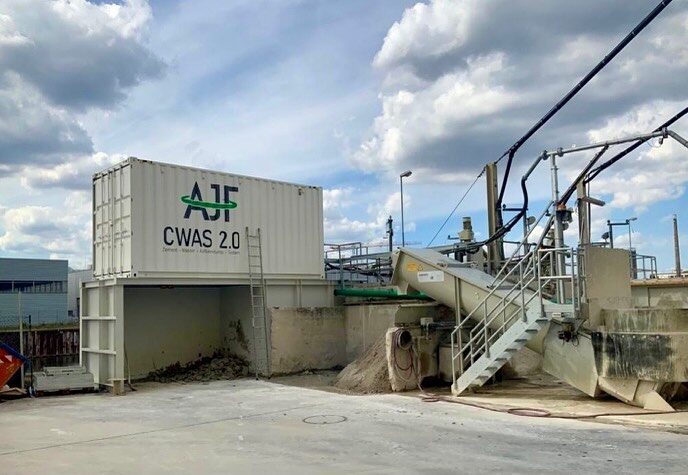
Recovery systems: How does a recycling screw work?
Low-wear and low-maintenance recycling screws (type RS6 or RS8) for the ready-mixed concrete industry do their job in the smallest of spaces, in many sizes and designs, with drive motors of varying strengths, screw lengths and screw diameters. With a sophisticated spiral arrangement, they are equipped with wear-resistant wash-out paddles; and a central lubrication system extends their service life. Let’s get started: feed the concrete recycling plant via the feed hopper from any angle. Do you collect residual concrete from the mixing plant cleaning process with a wheel loader? A practical wheel loader feeding device makes the work easier. Overfilling the plant? Don’t worry, because the shape and dimensions of the feed hopper prevent this – and the solids discharge height allows for a considerable storage volume. The washout screw prepares everything with a separation cut of 0.2 to 0.3 mm. Every hour, the screw carries away an impressive number of cubic metres of residual concrete solids with solid grain sizes of up to around 35 mm.
Need to clear away huge volumes quickly? Your trough thinks big.
Sometimes the intake and washing water volume is particularly large, meaning that considerable quantities have to be handled at very short intervals. Individually configured recycling plants with high washing capacity can handle even that! Everything, from residual water basins to the number of truck mixers to concrete pumps and engines, is designed on a larger scale. Trough and drum recycling plants are available in lengths of around 6,000 mm, and the solids discharge heights guarantee impressive storage volumes. Feed hoppers measuring 1,100 x 4,000 mm and with a capacity of 25 cubic metres per hour are not uncommon. Anything that handles this much material needs effective wear protection: if the screw shaft is positioned at a well-designed distance in the housing, a material bed can build up, minimising wear. A residual concrete recycling plant in trough or drum design saves time: at peak times, you can feed the plant from two truck mixers simultaneously, in one go, thanks to extra-wide feed hoppers. Modern washing plants can be optionally equipped with a scoop wheel for washing concrete pumps.
Out with the leftover concrete! Almost as if by magic…
The new residual concrete recycling systems also reduce personnel costs thanks to fully automatic control of all components: when truck mixers or concrete pumps approach, the flushing concrete washer starts via a sensor on the gallows – and uses recovered residual water. Residual concrete flows continuously into the inlet hopper; the screw conveyor transports gravel and coarse sand towards the discharge opening. Once a cycle is complete, the screw stops. The gallows, pump and agitators of this residual concrete recycling plant operate automatically after a pre-selected period of time has elapsed.
Considering purchasing a concrete recycling plant? Here’s what you should look out for
A good residual concrete recycling plant is versatile – whether it’s concrete with unbroken aggregates such as natural sand and round grain, broken aggregates such as crushed sand and grit, or completely new types of aggregates. Ready-mix concrete, precast elements, bridge construction, traffic areas, private house construction? Impermeable, high-strength, self-compacting, light or heavy? Innovative residual concrete recycling is part of sustainable, demand-oriented concrete production, in the form of mobile mixing plants for small to large projects. Sophisticated, economical concrete recycling is characterised by
– Flexible product customisation, on-time implementation
– Clear operation, intelligent control
– Needs-based concept comprising equipment and accessories
– Planning, production, assembly and commissioning from a single source
– Solutions for minimal wear and easy maintenance
How do construction companies and concrete manufacturers benefit?
Firstly, stationary or mobile recycling systems for concrete, process water and waste water are good for the environment: state-of-the-art environmental technology ensures the complete reuse of residual concrete and wash water produced on a daily basis – for sustainable material handling, from mixing plants to concrete pumps and truck mixers. Secondly, a residual concrete recycling plant gives you the opportunity to thoroughly clean gravel and sand, but also to reuse cement water in your operations – in a predictable, precise and economical manner. AJF has been designing and manufacturing resource-saving processing plants for the concrete industry for many years. Get started with us: clever concrete recycling is a well-rounded solution that benefits both the environment and your budget. Everyone wins!