











Do you use recycled concrete water in production? Then you are familiar with the problem: there are simply too many solids in the water – such as sand and cement – to achieve the desired concrete quality.
But whatever the cost, your concrete must meet all specifications – not least in terms of the water-cement ratio. So you add kilos of extra cement per cubic metre. Is this necessary, or can cement be saved even when using residual water?
Why correct dosing helps save cement
Magic? No, a patent-pending system based on the principle of water density standardisation. All you have to do is preselect the exact water density required; smart control technology does the rest. The CWAS system implements a complete raw material cycle, meaning you spend less on the disposal of residual water and sediment waste, on clear water and on additional cement.
Ingredients such as sand and aggregates, as well as water content, correspond to the quantities required by the recipe. Precise dosing reduces costs.
Ask yourself: Do I need to use the full two per cent deviation allowed in the total dosage? For a batch of two cubic metres with 3,700 kg of sand and aggregates, this can amount to 74 kg per mix! Saving cement means not compensating for deviations in aggregate dosage and water quantity by adding expensive cement to your concrete mix at a rate of between 5 and 30 kg/m³.

Save cement – with intelligent water treatment and automatic recycling
All this just to be on the safe side when it comes to concrete strength! Don’t leave such process decisions to chance: there is a more accurate, more predictable and more cost-efficient way. Saving cement when using recycled water in concrete? This can only be done effectively if the composition of the solids in the water is determined precisely in every detail – so that production can always be carried out with the correct residual water density. What’s more, the environment will thank you for reducing the amount of cement you use – even modern cement production still releases a lot of CO2. Intelligent water treatment using an automatic recycling system brings measurable savings in precious resources – and the concrete quality is just right!
What are the requirements of DIN EN 1008 for residual water tightness?
Residual water contains aggregates, cement, flushing water from truck mixers and concrete pumps, and possibly rainwater. The concentration of this aqueous fine material suspension varies depending on the origin of the residual water. The grain sizes are less than 0.25 mm. Only residual water with a solids content of less than 1% by weight of the aggregate may be added during concrete production. Only a certain percentage may consist of different aggregates. Solids that are not homogeneously distributed in the residual water must be separated in the settling tank. Details on sampling, testing and assessing the suitability of water can be found in DIN EN 1008. Residual water density, associated mass of solids and residual water volume can be found in the tables there and taken into account in the concrete composition. Further regulations for the reuse of concrete recycling water and for recovered aggregates can be found in the “Guideline for the production of concrete using residual water, residual concrete and residual mortar“, German Committee for Reinforced Concrete (Ri5).
How do you distribute residual water evenly across daily production?
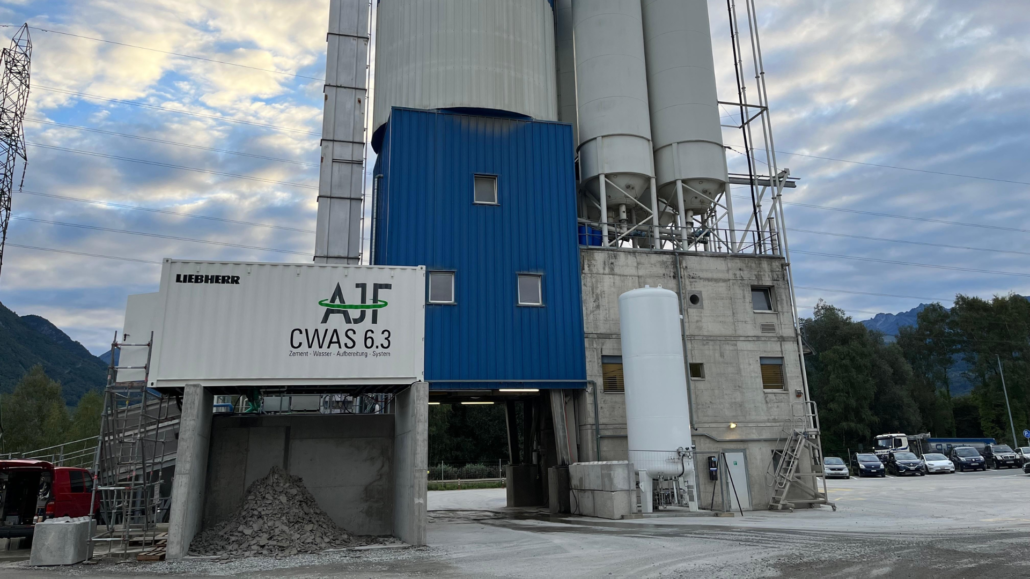
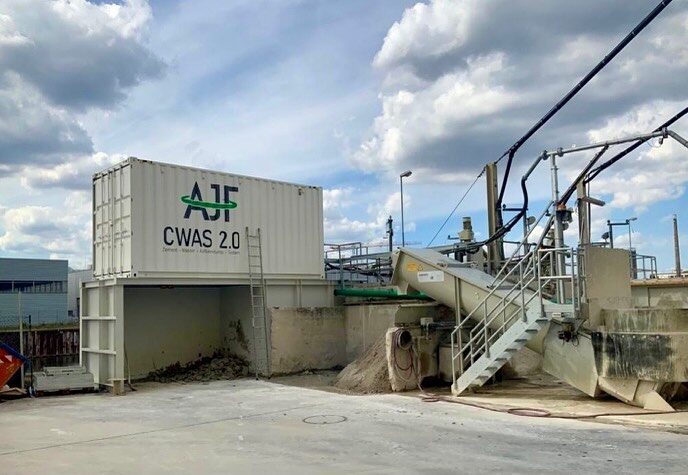
At least once a day, the residual water density in kg/litre must be determined at the time of the expected highest water density – or better still, continuously, around the clock. The average solid density is 2.1 kg/litre, with 1.07 kg/litre being optimal, with a solid mass of 0.134 kg/litre and a residual water volume of 0.936 litres/litre. Incidentally, for high-strength concrete or aerated concrete, you must not use recycled concrete water, only fresh water. But how can the requirement to distribute residual water evenly over daily production be realised in practice? Cement-water treatment plants such as the CWAS from AJF do the job automatically. Stationary but also mobile, the mobile recycled water treatment plant is also suitable for smaller concrete plants. Concrete water is automatically treated – even in winter operation, with a constantly low residual water density of, for example, 1.07 kg/litre.