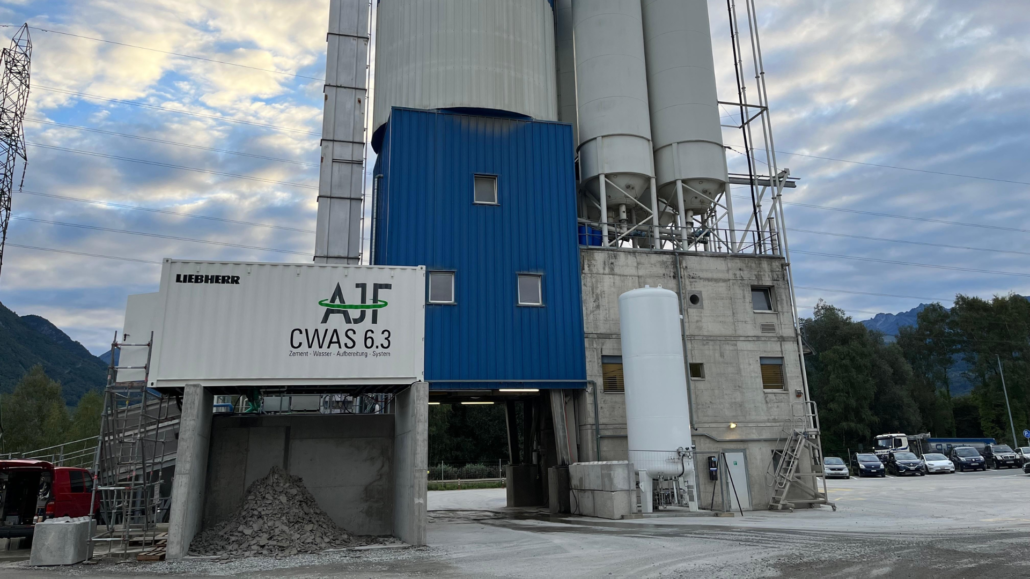












The problem has been solved, and Kutter Transportbeton has been able to increase its efficiency – conveniently and with full control thanks to AJF’s innovative water treatment system. The innovative technology went into operation in Darast/Woringen near Memmingen at the beginning of December 2020 and has been ensuring constant residual water density and fresh water savings ever since.
Kutter company: building construction, civil engineering and road construction, own ready-mixed concrete
Kutter has almost 100 years of experience in building construction, civil engineering and road construction, turnkey construction and precast concrete construction, plus asphalt paving and bitumen mixing plants. Its own ready-mixed concrete production ensures independence from suppliers. Kutter also supplies concrete to Austria, which complies with ÖNORM B 4710-1 in strength classes C 8/10 to C 35/45. Today, the founder’s grandsons, the Groll brothers, run the medium-sized company with 2,300 employees and headquarters in Memmingen, together with other managing directors.
Making ends meet? Only through consistent consumption of fresh water
Since the late 1970s, Kutter has also been well established in the field of road construction. Here, too, the motto is: do it yourself, if you can.
Wolfgang Mayer has been with Kutter since 2002 and is responsible for technology and fresh concrete at the concrete plant in Darast, Woringen. “In the past, we simply increased the density,” says Mayer. During the winter months, they just about managed with very consistent fresh water consumption.
Then, in 2020, the order came in for the A96 motorway bridge. “It was clear that we would need a lot of concrete that would need to be heated – and a corresponding amount of fresh water. It didn’t seem feasible to continue as before. Another problem was the reuse of our recycled material.”
Problem: Ensuring watertightness, even during winter operation
To ensure watertightness even during winter operation, the management sought a solution: last winter, the residual water level was very high. So Kutter considered: why not pump the recycled water into a separate container and leave it there for 24 hours? We drained the fresh water back out at the top. This works quite well in principle, unless the concrete slurry is too wet to be disposed of.
“While researching online, we came across the company AJF,” says Wolfgang Mayer. Contact was quickly established: could AJF solve the problem? Mayer highlights the advantages of the winter-proof cement water treatment plant. Problems with excess recycled water only arise when temperatures drop below freezing and normal concrete output is not as high. The requirement: to ensure that the water density is maintained at a value of 1.05 to 1.06 in order to guarantee the desired concrete consistency. “Excessive residual water density causes deposits in the plant, in the water pipes and in the spirit level – and is detrimental to the production of concrete.“
How water treatment works in the container
The AJF water density standardisation process uses intelligent, robust control technology that ensures constant water density in full compliance with DIN EN 1008. The maximum density value is reliably recorded and reduced by targeted removal of sediments or by adding fresh water. The required density values can be freely preselected with the CWAS system.
Instead of spending a lot of money on disposal, thanks to CWAS, a large proportion of the sediments are reused in concrete production via recycled water.
AJF residual water treatment: Individually tailored
The modular system can be expanded as needed. The finished system arrives pre-assembled so that concrete producers can get started right away with plug & play. The clean, compact solution saves water, energy and personnel costs. Wolfgang Mayer from Kutter Transportbeton comments: “AJF arrived on 4 December, set up the container and quickly connected everything. On 8 December, we pressed the first recycled water – everything has run flawlessly since then.”
Waterproofing can be maintained consistently
After the first winter, Kutter no longer has any problems with residual water and concrete slurry. “We can maintain our water density at a value of 1.05 or 1.06 without any problems and have a completely closed circuit,” says Mayer happily. This means that the company is no longer dependent on additional concrete when it comes to recycled water. This problem has been solved. He adds: “I can only recommend the AJF system, which works flawlessly. Anyone who deals with recycled water should really have a water treatment system like this. Whether it’s ready-mixed concrete or a precast plant – it just makes work so much easier!”