









Fully automated, highly developed, technically sophisticated – this is what the future of production processes in the concrete industry looks like. High quality requirements also apply to water as a raw material and process medium. The demands on water treatment are correspondingly strict, but it must also be economically viable. Things are happening in the water treatment sector! Water treatment plant manufacturers are striving to combine quality and efficiency. How does the concrete industry benefit from innovative, systematic water treatment?
The optimal water treatment plant for companies in the concrete sector?
It treats residual concrete water more efficiently because it is smarter. Efficient means, for example, consuming fewer resources and producing less waste and wastewater that is expensive and time-consuming to dispose of. In compliance with all environmental regulations, residual water is used 100 per cent, meaning it is returned completely to the water and raw material cycle. Water treatment plants for manufacturers who think sustainably want to help their customers secure substantial market shares in the future. And they have recognised that there is no one-size-fits-all solution that is suitable for all concrete manufacturers and concrete processors without distinction.
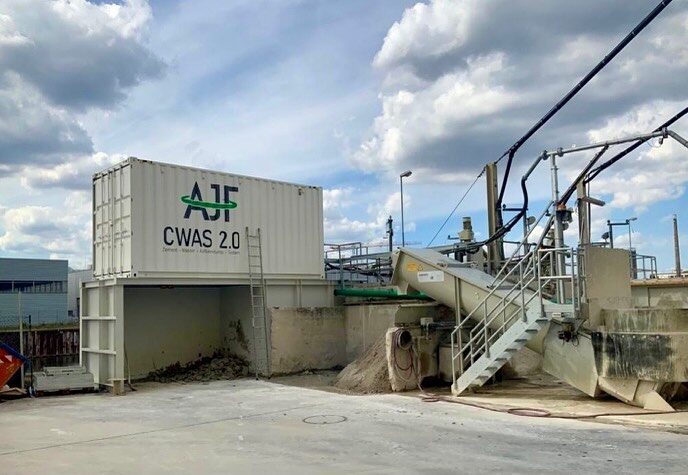
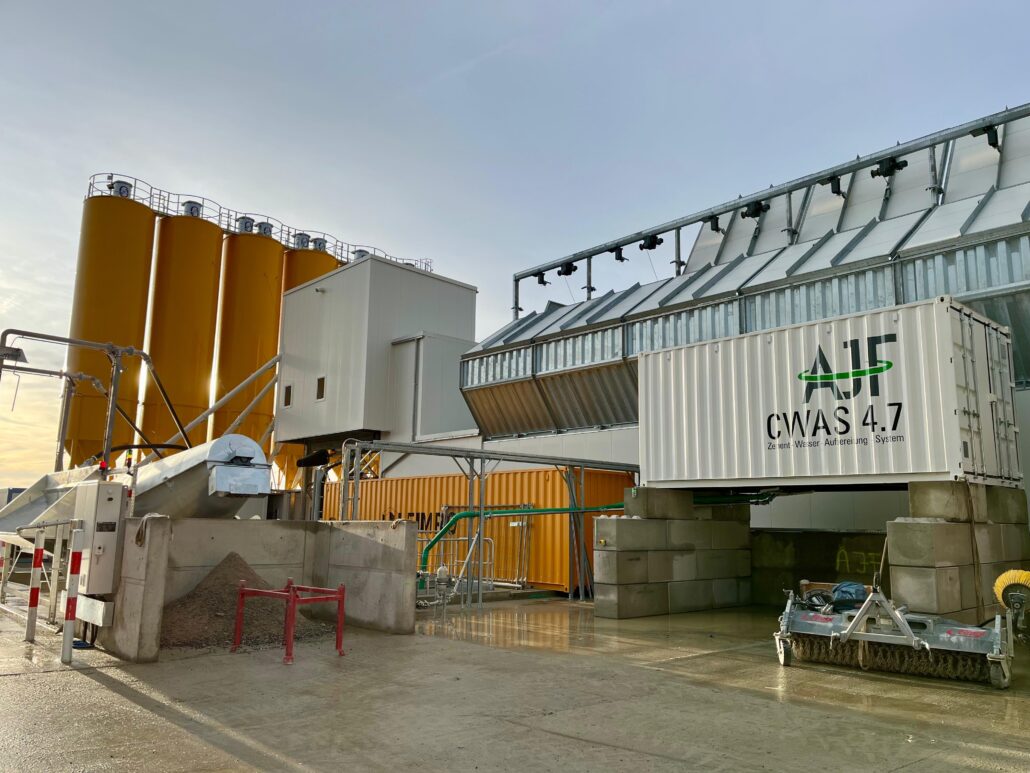
CWAS cement-water treatment from AJF: Tailor-made, fully automatic
Superior water treatment systems for concrete manufacturers achieve the goal of consistently low residual water density while precisely adhering to all water specification parameters – whether on site at the concrete plant or mobile on the construction site. The magic word is water density standardisation. Water treatment systems for concrete manufacturers can specifically preselect the density of each substance in the residual concrete water as well as the return water pH value.
Thanks to a pH neutralisation system tailored to the company’s specific wastewater volume, wastewater is discharged into the public sewer system safely, with a pH value that complies with legal requirements. Fully automatic pH measurement and final pH checks give manufacturers peace of mind. Grain size processing, binder dosing and evaluation stations for continuous testing of turbidity and solids content can also be accessed via the controller display module.
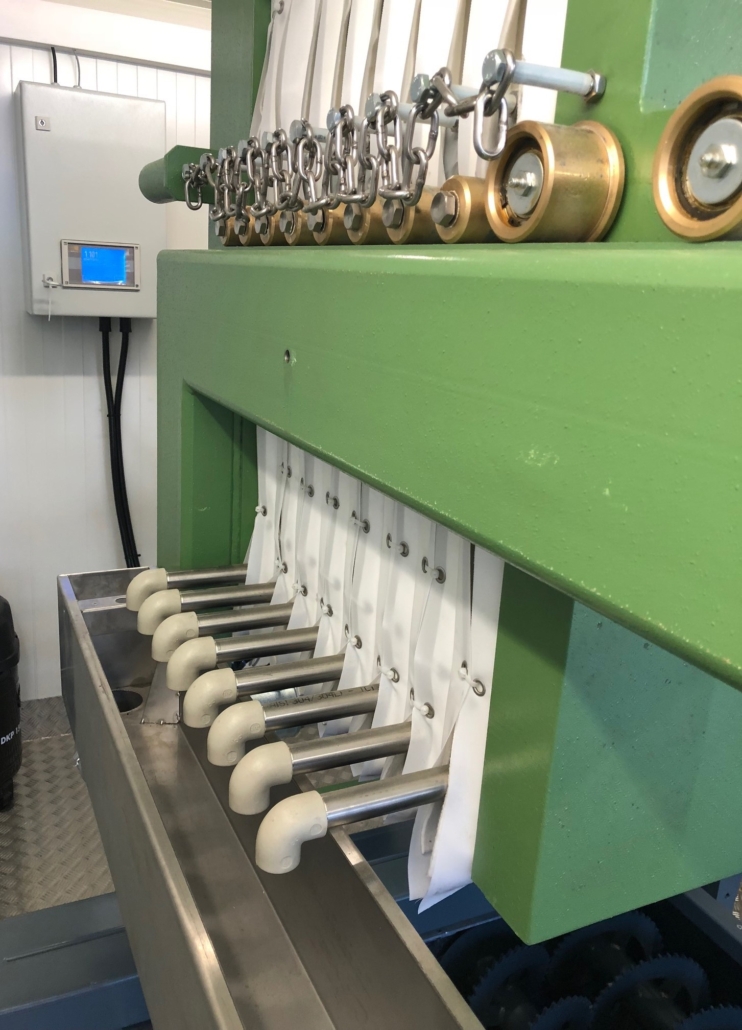
Effective flocculation and neutralisation of the finest particles efficiently treat water resources. Of course, the dosing station for flocculants is also tailored to individual requirements when it turns tiny flakes into large macroflocs. A modular – individually expandable – microfilter station for industrial requirements works with a needs-based selection of powerful special filters that reliably filter out even the tiniest particles.
Fully automatic water treatment systems for manufacturers such as CWAS also require very few staff: are flocculants running low? Integrated sensors report this immediately. Do components need maintenance? This water treatment system for companies in the concrete industry reports this itself.
Save cement – but still get the right concrete quality
Innovative water treatment systems for manufacturers of concrete components also reduce cement consumption. If the solids content is continuously and accurately determined, more recycled concrete water can be reused at a constant density – saving hundreds of tonnes of cement and CO2. Instead of regularly diluting water due to excessive residual water density, resulting in residual water quantities that then have to be disposed of.
Or, to ensure the quality and strength of components, add more expensive, environmentally critical cement. The solution? Water treatment plants for concrete manufacturers that meet the requirements of EN 1008:2002 for the use of recycled concrete water and work with intelligent density measurement, the values of which are incorporated into production control – with the aim of achieving a specific concrete quality.
As a concrete producer, you select the desired density of all materials in advance. Density too high? Targeted sediment removal or fresh water addition automatically reduces it. Positive side effect: sediments no longer have to be disposed of at great expense, but are reused in concrete production. Everything is integrated into a modular concept – from settling tanks to cisterns.
Whether it’s retrieving wastewater values or probe control, forward-thinking manufacturers of water treatment plants are stepping up to take every step off their partners’ hands, 365 days a year.
Concrete production of the future: automated from start to finish
Automation is the order of the day both nationally and internationally. Not only manufacturers of water treatment plants, but also concepts in the field of dosing systems and storage of aggregates are relying on it. Automatic bucket elevators, for example, enable fast, high-volume loading. Weighing systems are integrated into the bucket conveyors to ensure high precision in the dosing of aggregates – even where the quantities are significantly below the nominal volume of the mixer.
This minimises wear and tear on equipment and simplifies maintenance. Here, too, all processes are organised in a more targeted and controllable manner – from the speed of the mixing stars per mixing container rotation to the exact curve radius of the tipping bucket to its optimised driving and unloading process, controlled by a frequency converter for short transport times. The tipping bucket is connected via WiFi to a mobile chute, which moves into its predetermined position above the formwork to be concreted, precisely according to the production plan.
Central project management – from production planning to mixing recipes
Modern plant control is fully integrated into the existing company network. The aim is to achieve maximum automation in concrete production: production planning is stored in the system, and the production order is sent to the control system of the mixing plant via computer. All the production manager has to do is tick off the product in the order list. All concrete recipes are stored in the database.
Because it has long been established at what constant density the best strength can be achieved. Computer-aided project management makes it possible to supply even large construction projects with concrete elements at short notice. The ingredients required to achieve a specific concrete mix are precisely defined. Modern water treatment plants for concrete manufacturers are the key. Because the quality of the added water determines the setting time, strength development and compressive strength.
Networking, standardising and monitoring production processes in real time
For safety reasons, however, the concreting itself is not fully automatic but semi-automatic. After comparing the configuration with the values of the ordered product and checking whether there are still employees in the danger zone, the system gives the go-ahead for concreting. Finally, the computer calculates the necessary hardening time, etc. Every process is documented – and thus completely traceable, whether it is the production manager involved or the material batch used.
Every single raw material consumption is monitored in real time so that the production plan can be adjusted if reorders are necessary. And every step is standardised, with all reliable parameters known, resulting in a specific outcome: a specific concrete quality! In short, where production processes need to be streamlined, everything is networked and integrated into the digital enterprise system.
Why modern water treatment? Because it solves problems.
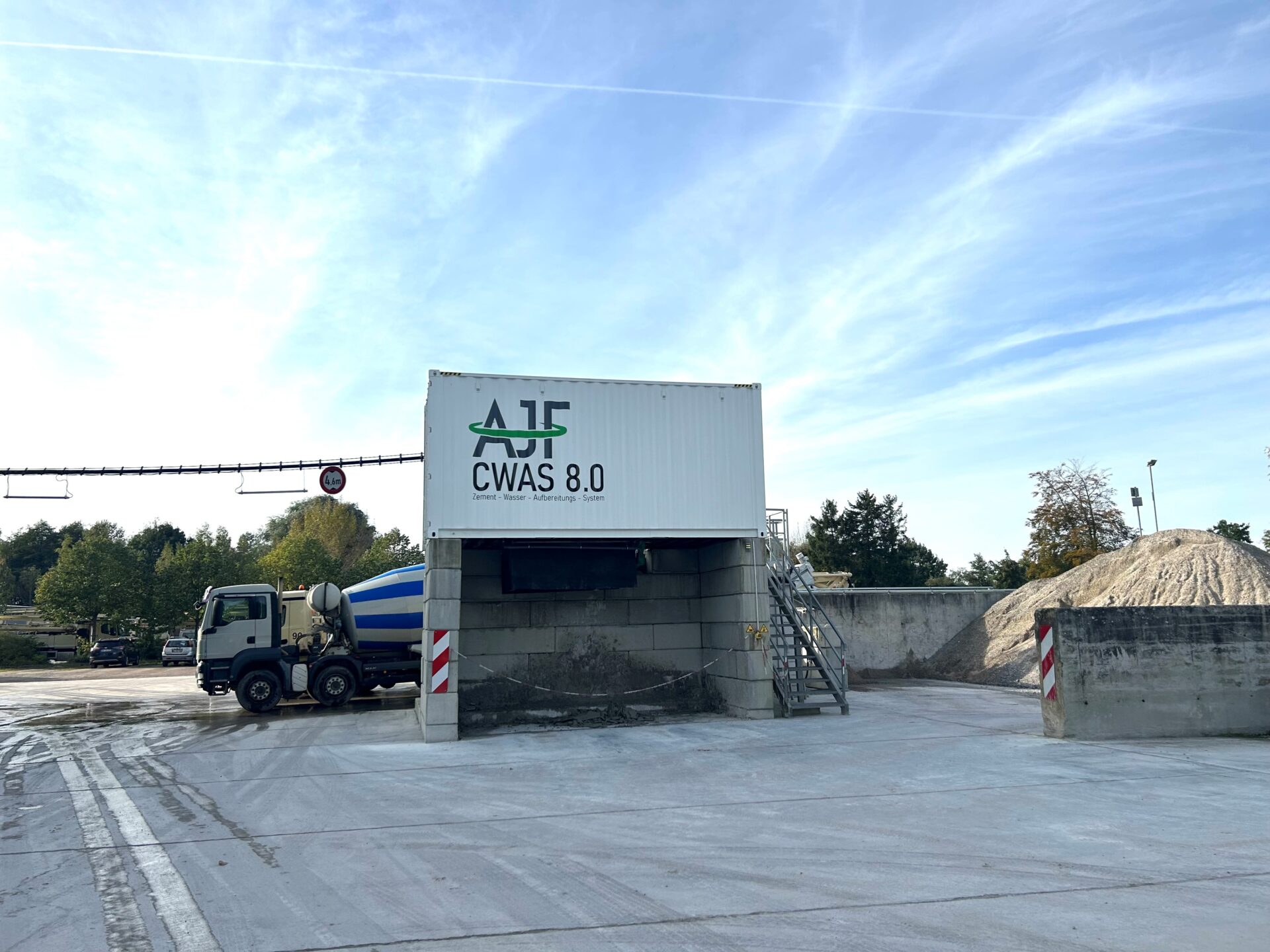
As a manufacturer of water treatment plants, we want concrete producers to rethink this issue. What’s in it for you? Continuous production with a complete raw material cycle all year round, integrated as a plug-and-play system in a compact mobile container that takes up minimal space – ready to use.
The control technology is easy to use and can be retrofitted to any machine design if requirements change. The concrete industry, precast plants and ready-mix concrete companies benefit from reliable, energy-efficient systems – from filter cake recycling to mobile concrete slurry separation tanks (mo-BAT) for water purification directly on the construction site.
Overflowing residual water basins, disposal and logistics costs are a thing of the past. Up to 100 per cent of the recovered water is used in concrete production. AJF industrial water treatment plants for manufacturers of fresh concrete ensure that not a single drop of recovered water is lost – it couldn’t be more environmentally friendly!
Break new ground now! Start systematic water treatment
It’s time to rethink familiar approaches and carry out targeted process optimisation. This will enable you to produce not only in a more environmentally conscious manner, but also more economically. Future-proof, tailor-made water treatment plants for manufacturers in the concrete industry quickly pay for themselves. And then? Work with us to expand your market position. Because everything is just right – sustainability, production efficiency and concrete quality!